A ladder cage, also called a back cage, is a steel framework that surrounds a fixed ladder or mast. For decades it was the standard form of fall protection for work at height in Europe. The logic was simple: a cage physically stops a person from falling off, so it seemed like there was little that could go wrong. In practice, a great deal could go wrong.
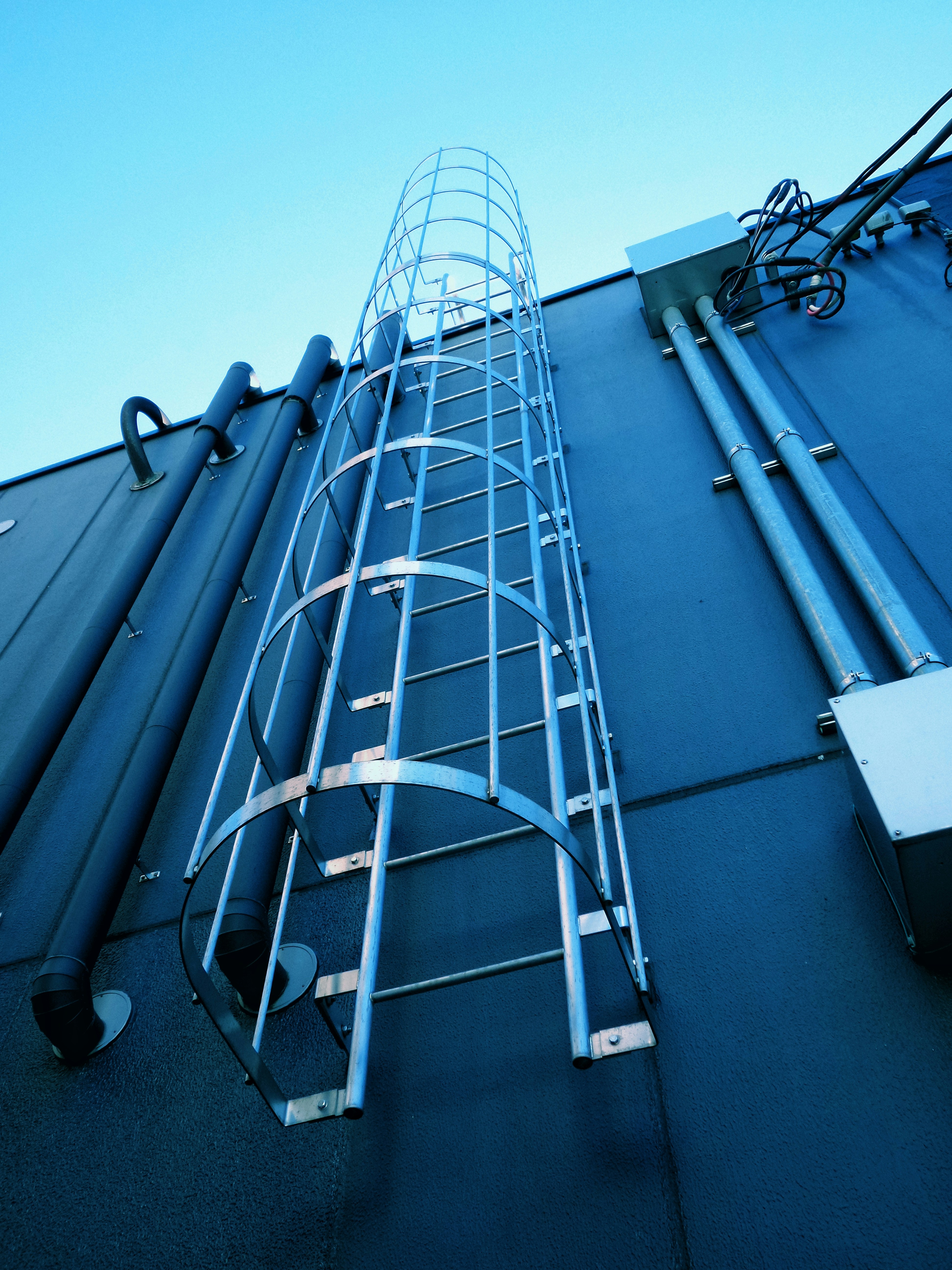
The Reality of Ladder Cages
Ladder cages only work under certain conditions. Accident data shows what happens outside those conditions:
A climber carrying equipment loses balance, and their body swings outward. The cage stops the swing, but it does nothing to cushion it. The impact hits the ribs, spine and pelvis hard enough to break bones. Many workers also got into the habit of leaning out of the cage to get a better view of their work, which created fall paths the cage was never designed for. Some accidents involved workers falling through poorly maintained sections of the cage.
By the 1990s, European incident databases showed a worrying trend. Cages reduced how often falls happened, but they couldn't reliably prevent injury once a fall occurred. The design had a fatal flaw: it assumed workers would always stay inside the cage, and they didn't.
A Turning Point from Medical Research
In the late 1990s, biomechanical research changed how engineers approached fall protection. Researchers reached a conclusion that surprised many people: barriers alone cannot prevent falls from height. Workers find ways around them, squeeze through them, or create new failure modes.
So the key question changed. It was no longer "How do we stop people from falling?" It became "What happens to the human body during a controlled fall, and how do we keep the harm to a minimum?"
Research on fall arrest systems showed that the human body can safely withstand deceleration forces of about 4–6 kN, or roughly six times body weight, as long as that force is spread over enough distance and time. Above that limit, internal injuries occur. If a fall is too fast and nothing slows it down, the forces can be fatal.
This finding changed the whole approach to fall protection: stop the fall gradually, not abruptly.
The Technology Behind the Change
Guided type fall arresters came directly out of this research. The climber wears a full-body harness connected to a rigid rail or a tensioned wire and moves along a fixed path. If the climber falls, the arrester locks. The design still allows a short deceleration distance, sometimes only 30–50 cm, which lowers the peak impact force.
The key advantage of a guided fall arrest system is that it works no matter how the climber behaves. Workers don't have to stay inside a cage or remember to clip in correctly. The system's mechanics stop the fall automatically.
EN 353-1, first published in 2001, set this technology down in a standard. By 2008 it had become the preferred standard across Northern Europe, and by 2016 EU harmonisation had made it binding throughout Europe.
How the Standards Evolved: From Passive to Active Protection
Phase 1: The Cage Era (1970s–1990s)
Ladder cages are a form of passive restraint, meaning a physical barrier. They have no moving parts, need little maintenance, require no training, cost little and are easy to install. However, accident data showed that cages fail as soon as workers behave differently from what the design expects.
Phase 2: The Transition (2000–2010)
During this decade, EN standards began to separate out different approaches to protection:
EN 354/355 (lanyards and energy absorbers): specify how fall arrest equipment should slow down a fall
EN 360 (retractable type fall arresters): provide personal protection for work situations that require freedom of movement
EN 353-1 (guided type fall arresters): began standardising the new technology that would replace cages
Regulators had to choose between continuing to allow cages and requiring an upgrade. The accident data made the case for upgrading.
Some countries, notably Germany, Austria and Switzerland, moved faster than others. Under DGUV regulations, Germany had largely phased out ladder cages by 2012. Other European countries moved more slowly, but the direction of travel was clear.
Phase 3: Harmonisation (2010–2020)
The EU's approach to safety standards is harmonisation: a single set of standards across all member states, which removes the confusion caused by different national versions. For fall protection, this involved:
Bringing the various cage designs together under a single standard, EN 353-1
Requiring CE marking and EU type-examination certification
Setting up inspection and maintenance procedures (EN 365)
Specifying rescue equipment and rescue procedures
By 2020, any European operator still relying on unregulated ladder cages faced pressure from regulators as well as insurance problems.
Phase 4: Current Standards (2020–2026)
Today's standards draw on more than 20 years of safety research:
EN 353-1 now covers both rigid rail and tensioned wire systems, because wire systems are often the better choice for retrofit projects.
EN 50308 adds requirements specific to wind turbines, because rescue in a turbine is complex and needs extra safeguards.
EN 365 requires documented inspections and rescue plans, because equipment on its own is not enough without systematic management.
EU 2023/1230 (the Machinery Regulation) extends these requirements to manufactured systems such as climb assist devices.
Why This History Still Matters
Current standards are not arbitrary red tape. They are evidence-based requirements developed from decades of accident analysis and biomechanical research. EN 353-1 systems are used because the accident data proved they are needed. Documented rescue plans are required because rescue response time can decide whether a worker survives.
Ladder cages tried to protect people from their own behaviour. Modern fall arrest systems protect people from physics.