Different hazard profiles demand different protection logic. This article compares four industries across risk characteristics, CN/EU standards, technical solutions, and inspection regimes — enabling you to understand the risks, select the right system, and calculate true lifecycle costs.
Quick-Reference Comparison
Industry | Key Risks | Key Standards | Core Solutions | Inspection Focus |
Construction | Frequent repositioning; mixed horizontal/vertical work; multi-trade use | EN 795:2012, EN 353-1/-2, GB 6095-2021, GB 24542 | Horizontal lifelines / vertical lifelines / guided fall arresters / SRLs; twin-hook harnesses for transitions | Daily + weekly checks; anchor load verification (EN 12/18 kN; OSHA ≈ 22.2 kN) |
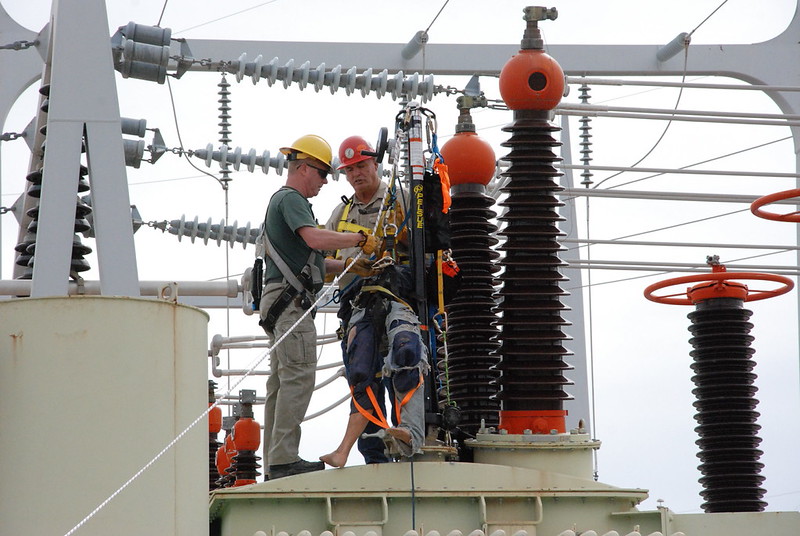
Power Line Maintenance | Two-phase risk: climbing + prolonged suspension; insulation requirements | GB 24544-2023, EN 353, live-line insulation specs | Two-phase protection: Climbing (overhead-anchor arrester / vertical lifeline) + Work (SRL + work positioning) | SRL braking tests, rope wear, insulation assessment |
High-Rise Cleaning | Extended suspension, isolated work, short rescue window | EN 1891, EN 12841, GB 24543, GB 19155 | Bosun's chair (dual-rope system) / suspended platform (platform + independent safety rope + rope lock) | Professional rope damage inspection (every 6 months), descender wear |
Wind Turbine O&M | Extreme height, extreme weather, high impact energy | EN 353-1, GWO certification, EN 361 / GB 6095-2021 | Traditional climbing (guided fall arrest + climb assist) / mechanized ascent (service lift + safety wire with fall arrest lock) + self-rescue descent gear | GWO annual inspection, corrosion assessment, harness checks every 6 months |
1. Construction: Balancing Flexibility with Reliability
Horizontal lifelines (EN 795 Type C flexible / Type D rigid rail) for continuous hands-free movement
Multi-user simultaneous connection for extended work areas
Vertical lifeline + self-locking device (EN 353-2 / GB 24542): auto-tracking with instant lock-on fall
Fixed ladders: rigid rail guided fall arresters (EN 353-1) preferred for shorter, more controlled arrest distances
Overhead anchor + SRL (GB 24544-2023) or energy-absorbing lanyard
2. Power Line Maintenance: Two Phases, Two Protection Layers
Retrofit fixed vertical guide rails on existing lines — one-time cost, long-term benefit
Drone-deployed top anchors to eliminate the unprotected first climb
Interim: twin-hook alternating climb with continuous step-bolt connection
Short-distance overhead anchor + SRL: minimizes fall distance and impact force (GB 24544-2023: ≤ 6 kN, ≤ 2 m), preserves mobility, limits suspension time
Work positioning distributes body weight off the fall arrest system
3. High-Rise Cleaning: Three Methods, One Principle
Working rope carries the operative and load (EN 1891 low-stretch kernmantle); safety rope has an independent anchor and connection (GB 24543). Either can fail without compromising the other.
A national standard (Safety Specification for Bosun's Chair Suspended Operations) is under development by China's Ministry of Emergency Management.
The platform carries the operative, but the harness connects to a safety rope anchored independently to the building via a rope lock — if the platform fails, the operative remains attached to the building.
Same logic as the dual-rope system: work and life-safety are always separate.
Per JGJ 80-2016, bosun's chairs and self-fabricated platforms are prohibited on construction sites. Bosun's chairs apply only to cleaning and maintenance of existing buildings.
4. Wind Turbine O&M: Two Ascent Routes Under Extreme Conditions
EN 353-1 rigid rail guided fall arrest (GB 24542) — full-travel tracking, instant lock
Optional climb-assist device: motor-driven traction provides ≈ 30–50 kg of assistive force. The operative still climbs; the guided arrester remains primary protection.
Equipment-level redundancy: working wire rope carries the load; safety wire rope is normally unloaded with a fall arrest lock — on working rope or traction failure, the lock immediately arrests the carrier
Personal fall protection retained: full-body harness, personal arrester, and rescue descender worn at all times — forming a dual-layer "equipment + personal" system
CN–EU Standard Cross-Reference (Current Editions)
Element | EN Standard | CN Standard | Core Requirement |
Anchor Devices | EN 795:2012 | GB 30862 | 12 kN (metallic) / 18 kN (non-metallic load-bearing) |
Full-Body Harnesses | EN 361 | GB 6095-2021 | Body + load ≤ 100 kg; impact ≤ 6 kN |
Guided Fall Arresters (Rigid/Flexible) | EN 353-1 / -2 | GB 24542 | Auto-tracking, instant lock, limited fall distance |
Safety Ropes | EN 1891 | GB 24543 | Low elongation, high breaking strength |
Self-Retracting Lifelines | EN 360 | GB 24544-2023 | Impact ≤ 6 kN; fall distance ≤ 2 m |
Connectors | EN 362 | GB/T 23469 | Auto-closing gate, anti-inadvertent opening |
Inspection & Maintenance: Cutting Corners Here Costs More in Incidents
Construction → Daily visual + weekly functional testing of critical components
Power Line → SRL performance testing (lock speed, braking distance, peak impact) + periodic insulation testing
High-Rise Cleaning → Rope damage assessment every 6 months + descender friction-part wear check
Wind Turbine O&M → GWO annual inspection + corrosion assessment (especially offshore salt spray) + mandatory retirement cycles
Four-Step Selection Method
Assess the environment — Horizontal or vertical? Fixed or mobile anchors? Suspension duration? Extreme weather or insulation needs?
Apply current standards — GB 6095, GB 24544 and others have been revised; do not cite superseded editions. CN/EU/US limits differ; international projects require dual certification.
Calculate lifecycle cost — Low purchase price may mean higher inspection frequency and shorter retirement cycles.
Formalize rescue plans — Wherever fall arrest is deployed, a rescue plan is mandatory, including suspension trauma postural management.
Conclusion: Four Industries, Two Iron Rules
① Zero Protection Gaps — Twin-hook alternating in construction, overhead anchoring in power, full-travel tracking in wind — all eliminate "the few unprotected seconds.">② Load-Bearing / Life-Safety Separation — Dual ropes in cleaning, independent safety lines on platforms, working + safety ropes on service lifts — all ensure "if the work system fails, the life-safety system holds."